
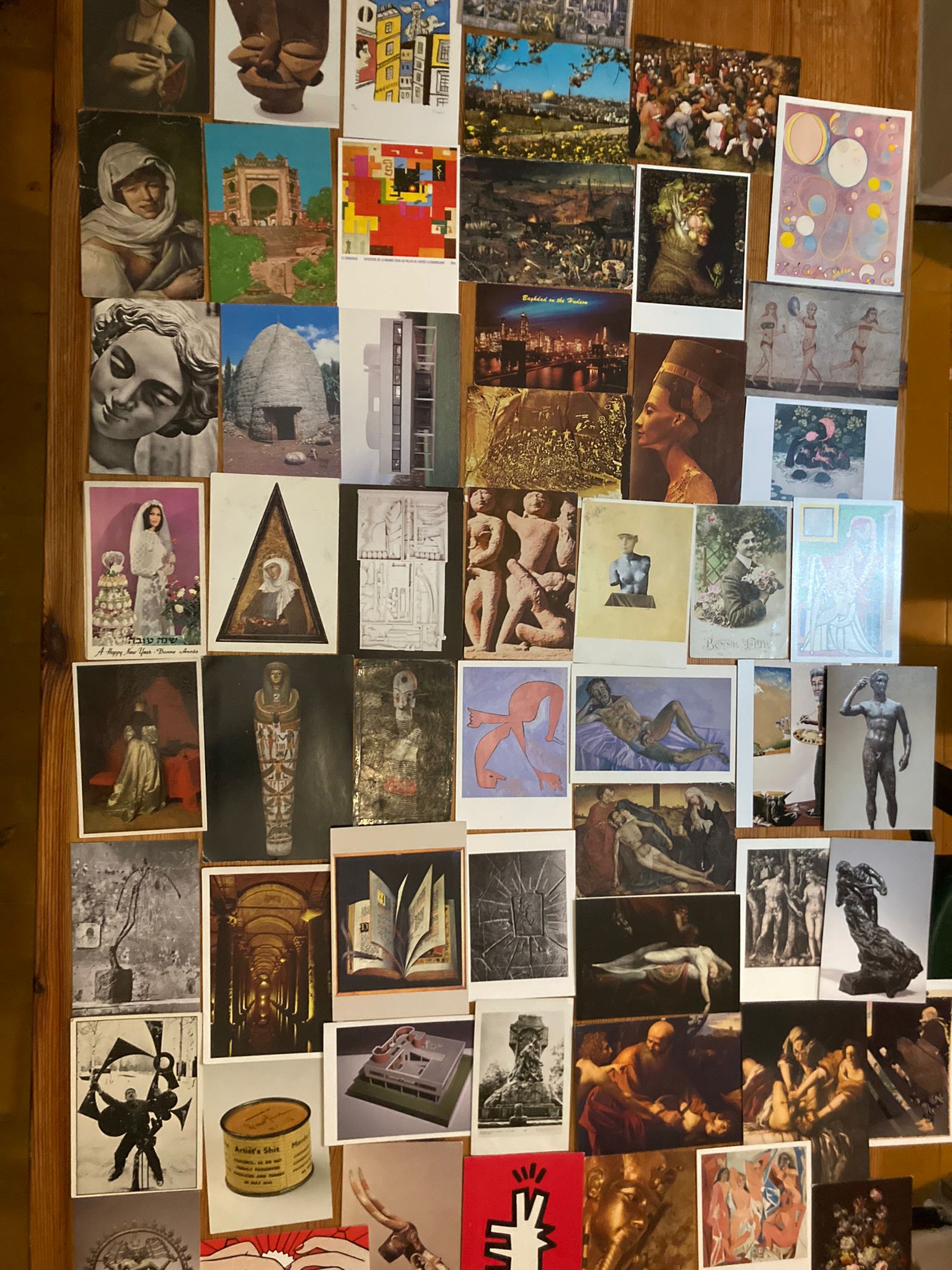


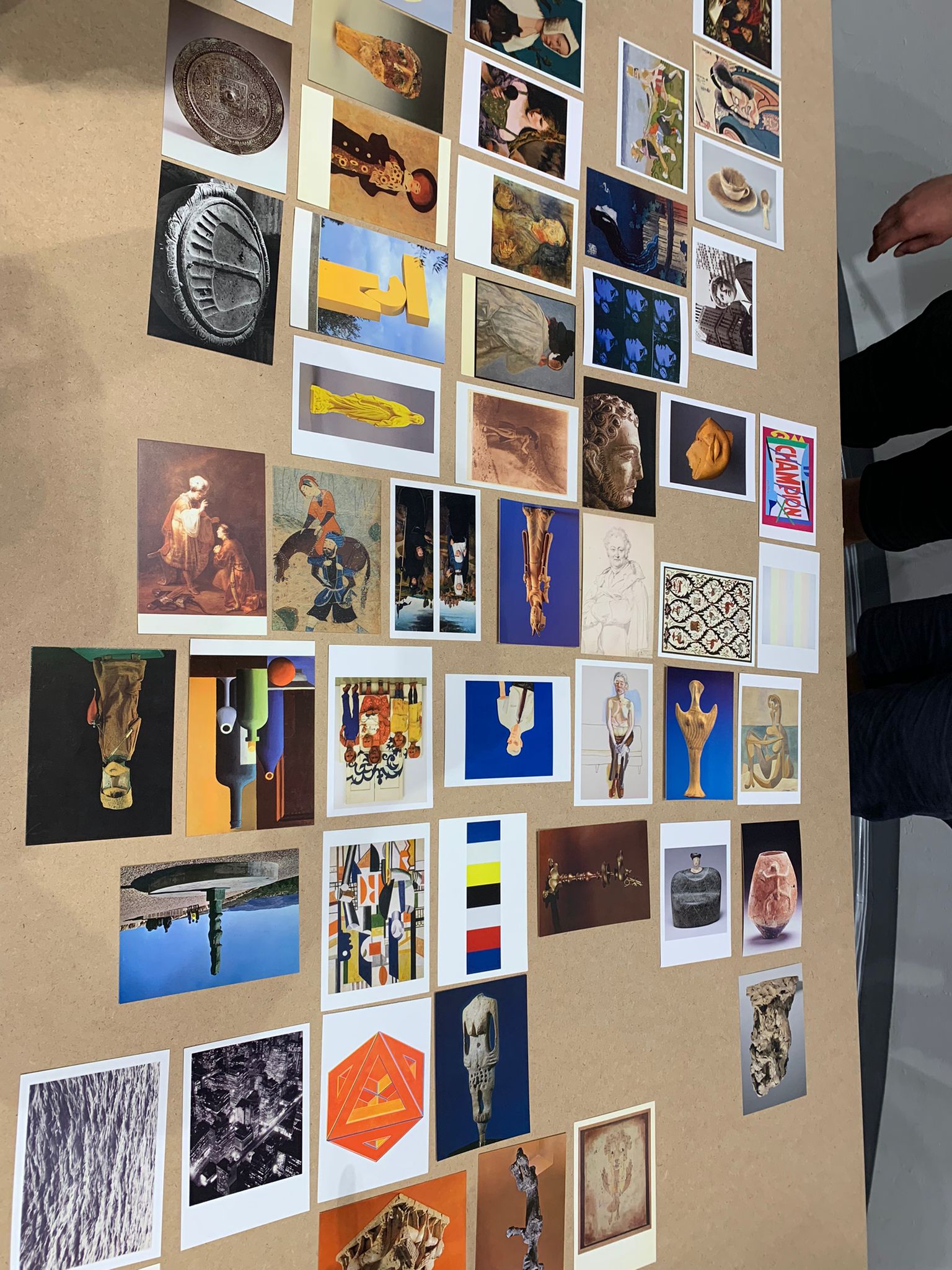
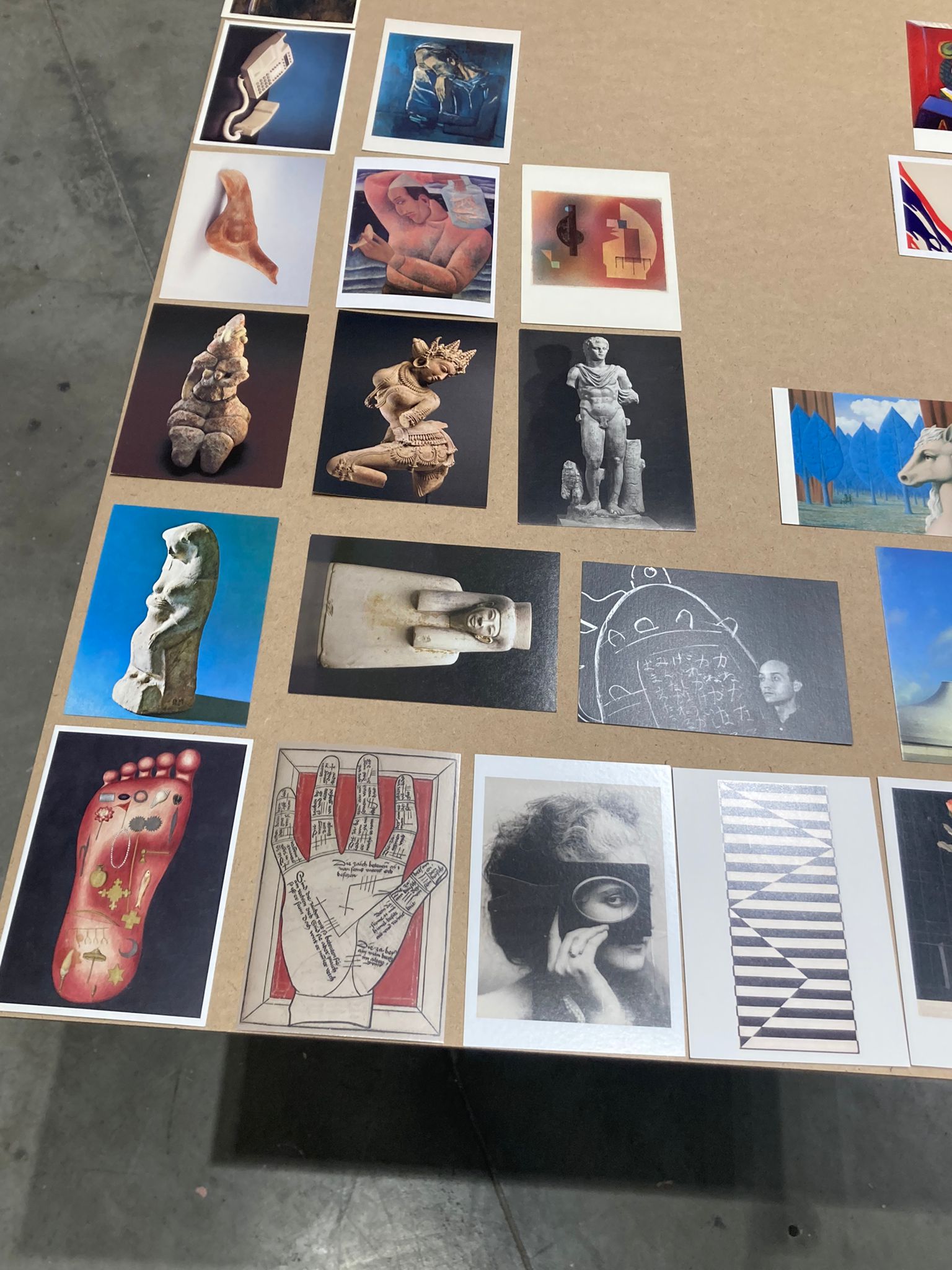
Postcards is an open-ended, turn-taking game. It comprises printed postcards drawn from museum collections around the world. The postcards present reproductions of a wide array of artworks and artifacts, ranging from contemporary art to archeological objects. The box set includes over 300 postcards and a booklet with instructions and suggestions for different ways to play.
At its core, Postcards is based on a seemingly simple act—the placing of images side-by-side. Players are invited to collectively create unique grid-composition layouts, playing from “hands” of postcards drawn by chance from the box set. These layouts are generated over the course of the game, as players, in turn, make different visual connections between images based on composition, iconography, gesture, narrative, materiality, color, shape and other perceived affinities. The connections are inherently individual and unique to the specific moment of play and the dynamic of the playing group. They are expressive of the inner worlds and particular ways of thinking of the players themselves.
The final layout of cards becomes a sort of Tarot card spread or Rorschach test for the collective makeup of the group of players. The gameplay deliberately eschews the linearity of art historical narratives and traditional academic approaches to the study of visual culture. Postcards seeks to revive a sense of wonderment that arises at seeing artworks encounter one another—artworks separated by time and space, and which come together only through the act of play.
The game draws on the history of photographic reproduction in art history, including André Malraux’s Le Musée imaginaire, Aby Warburg’s Mnemosyne Atlas and David Hockney’s Great Wall. The game encourages close looking and observation. It develops intuitive and associative thinking, deepens familiarity with art history and stimulates the discovery of new ways of seeing art.
The game was developed by the artists Tomer Rosenthal, Rotem Linial and the art historian Jesse Lockard along with the many artists friends and students who have played the game in its various iterations, honing its rules, structures and forms. The current prototype was developed by Tomer Rosenthal, Rotem Linial and Jesse Lockard.
Thanks to The Wilfrid Museum, Tel Aviv Museum of Art, The Israel Museum, Hila Cohen-Schniderman and Ido Feder for their help and support with the realization of this project.